Honestly, such a decorative coating on ordinary wallpapers is not much like it ... It ...

|
|
In the modern world, the development of building technologies is so rapidly that ... |
Sliding partitions are widely used to decorate the interiors of residential buildings. It... |
The retaining wall on the site: device, materials, features. Master Class
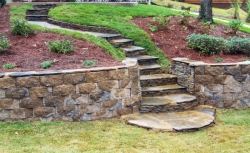
Not every owner boasts a perfectly even relief, hence the conclusion - the retaining walls on the site are an absolutely indispensable element, which can become not only a good decoration of your garden, but also a structure that divides it into zones.
The process of erecting a retaining wall with your own hands is not complicated, in the course of it you can realize the most diverse fantasies of landscape design. In this article, we will consider all the important nuances in the construction of a retaining wall with our own hands.
Table of contents
- Device and functions of retaining walls
- Parameters on which the stability of the retaining wall depends
- Key aspects when organizing a retaining wall
- Underground part - types and arrangement of the foundation
- Drainage, drainage and waterproofing - a guarantor of reliability and durability of the retaining wall
- Materials for the manufacture of retaining walls with your own hands
- How to make a retaining wall on the site with your own hands- master class
- Landscaping walls in landscape design
Device and functions of retaining walls
The designs of retaining walls can differ from each other, since each performs its function of strengthening or decorative, and each is designed for a certain degree of influences, but the wall of the wall is the same, it consists of the main elements:
- The foundation is the underground part
It is he who withstands the entire severity of the soil pressure.
- The body is the ground part
The inner side of the wall is in contact with the ground, circling a hill on the site. The outer side (front) is open, can be even or oblique.
- Drainage and drainage security communications
During the design of the design, it is necessary to provide methods for the removal of excess water and moisture, which will always accumulate behind its inner surface.
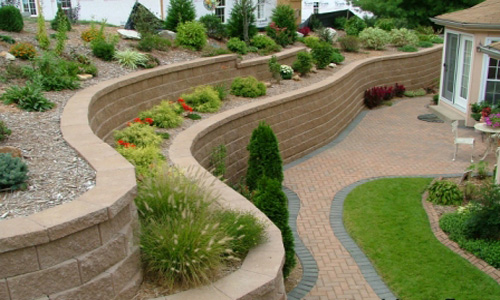
The retaining walls simultaneously combine several function:
- perfect zoning the site;
- excellent transformation and become a decorative-artistic element of the landscape;
- perform unsurpassed fortific and protective function;
- they will solve the problem of unevenness of the site.
Parameters on which the stability of the retaining wall depends
The retaining wall should be as stable as possible, capable of withstanding high pressure, in a different option there is a huge probability of destroying the structure and sliding of the soil. Therefore, all factors that affect its strength should be calculated.
The following physical forces act on the wall:
- own weight of construction;
- soil pressure that the wall holds;
- friction and grip forces;
- additional weight of the elements that can be on it.
Phenomena affecting the design:
- soil swelling in the winter;
- wind (if the height of the wall is more than 2 m);
- vibrations (if, for example, a railway is laid nearby);
- seismic phenomena (depending on the characteristics of the region)
- washing with rainwater.
Another factor affecting the stability of the structure is the thickness of the wall. It depends on the type of soil and the height of the structure, the softer the soil and the larger the height of the support, the wider the protective shield should be.
Key aspects when organizing a retaining wall
The retaining walls are a complex engineering design, therefore, when arranging it, a number of factors should be taken into account, on which their strength, reliability and durability depends. Of course, it is better to entrust this matter to specialists, but having certain specific skills and knowing all the conditions under which the construction is possible, it is possible to independently carry out the construction of the structure.
- The construction of retaining walls is possible only on stable soils of crushed stone, clay, gravel, sandy loam, etc.
- For successful arrangement, it is important that the level of freezing of the soil becomes no more than 1.5 m from the surface of the Earth.
- Groundwater should pass below 1 m, and preferably 1.5 m from the surface of the earth.
- With independent arrangement, it is necessary to remember that the ground part of the retaining wall should not exceed 1.4 m. It will be better to turn to professionals to build a higher support structure, since this requires special calculations that take into account the pressure of the soil and its mobility.

Underground part - types and arrangement of the foundation
A retaining wall in which the height becomes more than 30 cm must have a reliable foundation.
The general rule when organizing the foundation: the softer and unstable the soil, the more the depth of the foundation should be.
Desired proportions of the depth of the foundation and the height of the support depending on the loosen of the soil:
- If the soil is quite dense, then the ratio of the depth of the foundation and the height of the aboveground part should be 1: 4, respectively.
- If the earth is of medium loose, then the depth of the foundation becomes 1/3 of the height of the support.
- If the soil is loose, soft, then the depth of the foundation of the wall should be its height.
The foundation can consist of gravel, crushed stone, concrete, compacted cement or heavy clay.
Drainage, drainage and waterproofing - a guarantor of reliability and durability of the retaining wall
When equipping the support, it is not enough to provide a high -quality foundation and reliably install a retaining wall on it, it is very important to protect the structure on the back of excess moisture, which exerts a destructive effect on it.
Regardless of the material, size and shape of the retaining wall, to prevent water and moisture accumulation, which have a destructive effect on the structure, it is necessary to organize a drainage and drainage, as well as if necessary, waterproofing the inside of the support.
Organization of drainage
The drainage wall is divided into transverse, longitudinal and combined.
The transverse organization of the drain implies the installation of holes in each 2 or third row of masonry with a diameter of not more than 10 cm or pipe under inclination so that the water immediately goes beyond the site.
With a longitudinal drainage, as it is often called the underground, along the retaining wall under the soil at the foundation level, a corrugated, ceramic or asbestos-cement pipe with a diameter of 10-15 cm is laid, shrouded in geotextile material, which absorbs water that falls later through small holes into the pipe and diverted behind limits of terases.
To prevent atmospheric water from entering the masonry design, which at a minus temperature will lead to the destruction of the retaining wall, it is necessary to provide a visor or cornice block with some slope.

Drainage layer between soil and wall
After assembling the wall and several days of its downtime, it is necessary to transgress to fill the space between the slope and the wall itself. For this, large -sized soils, for example, gravel, pebbles, large sand, are best suited. Also, small pieces of brick and the rest of the waste materials are often used for this. Not given that gravel exerts considerable pressure on the support, it serves as an additional drainage layer.
The drainage mixtures and soil fall asleep in layers, where each separate layer is crumpled. Large -clamp soils and sandy sands are considered more preferable.
On the upper part of the styling material, it is best to use vegetable soil. After the last layer of the retaining wall is compacted, it is necessary to leave it in this state for several weeks without giving it loads. Thanks to this, the strengthening material will gain all its properties. It is very important to lay on top of a previously removed soil layer in which there is enough humus. Having done all the above work, you can safely start arranging a terrace.

Waterproofing - additional reliability and durability of the structure
To increase the life of retaining wooden, brick, metal, concrete walls, their waterproofing from the soil is necessary. To do this, you can use the following materials: roofing material or roofing only applied in two layers. You can also coat the inner surface with bitumen or mastic with dry soils.
Materials for the manufacture of retaining walls with your own hands
First of all, before choosing a material for a retaining wall, one should clearly understand its purpose. The description above has already stated that the retaining wall can be a fortification, as well as a decorative component of the garden section.
If the retaining wall will serve as a strengthening element of steep inclination or terrain, then for its construction it is best to use natural stone or concrete. For example, the area, which is located next to the railway, constantly lends itself to soil vibrations, and under such pressure more fragile materials will very quickly lose their properties, which will ultimately affect the reliability of the wall.
That's when the retaining wall is installed in order to add a decorative element and is not subjected to physical activity, then gabions, wood or brick can be used as a material.
Wooden retaining walls
This type of creation of a retaining wall is considered cheap in installation, but the installation process itself is not so simple and will take more than all time. To create and install it, it is initially necessary even, high -quality wood. A more simplified construction method is the vertical arrangement of logs, tightly fitted to each other. The log in diameter from 12 to 18 cm in diameter is considered the most optimal for wooden support walls. The height of the log depends on what height of the support wall you are going to build. Determining with its height, do not forget to take into account the fact that at least 50-60 cm will have to be spent as installation of a retaining wall, burrowing this part into the ground.
The logs are located strictly vertically and up to each other. On top of them it is necessary to tightly wrap them with wire, and to prevent displacement, they can also be connected with nails. To ensure maximum stability after fixing logs, the trench is completely poured with concrete.
Preventing rotting of a tree, part of which will be constantly in the ground, it is best to lubricate it with machine oil.

The next method is a more difficult fence in the construction, since in it vertical logs are established with certain gaps. Special holes are created into which are installed tightly to each other, logs with a smaller diameter.
To create it, you need high -quality and even logs, since rotten wood will very quickly turn your efforts and time spent into continuous disappointment. Most often, the easiest option is used - vertically located logs, which are tightly joined with each other. The recommended trunk diameter is the same as that of the described method, but the part that goes into the ground is slightly smaller and is 40-50 cm. This long is enough so that in the spring they stand firmly and do not shift when the earth usually absorbs moisture in several times more.
Concrete retaining wall
This design is considered the most durable and thorough. The process of its construction begins with the fact that you need to dig a trench, which will be an accurate reflecting of the wall around the perimeter. The depth of the trench depends on the height of your wall.
At the bottom of the trench we lay a mixture of gravel and crushed stone, then the reinforcement, which we fix with coherent wire, and only then we remove the formwork. We make formwork from boards, the thickness of which is not less than 25 mm and no more than 45 mm. With the help of screeds or nails, we give the construction of the fortress, so that in the future it does not crumble, deforming the concrete. Under the pressure of the mixture, it is possible to bend the side walls of the formwork and to warn them, we score metal rods with an interval of up to 1.5 meters.
After all the preparatory work on the strengthening part of the retaining wall, evenly pour concrete. A few days later, when the wall is formed, the formwork can be removed with bumps, they can be trimmed with plaster.
The transition to the next level is facing work in which everyone chooses the material to their taste.
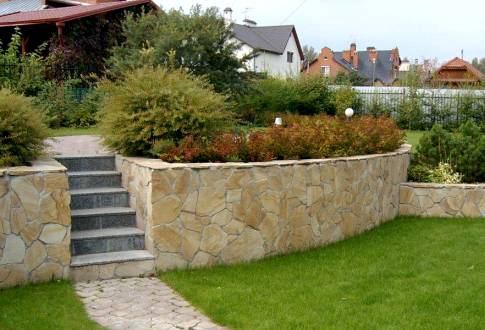
Brick support
The technology of laying a brick wall is the same as in ordinary construction. The only difference between them is a reduced thickness of the structure. A wall not exceeding a meter of height is laid out in half a brick, if higher, then whole. The facing material for the brick wall is used the same as for concrete.
This structure requires the foundation, and the depth of its foundation will completely depend on the final height of the wall, the composition of the soil and the degree of freezing. As for the width, as a rule, it is 20-30 cm more from the most retaining wall.
In the process of building the wall, it is very important to observe the ratio of length to thickness (1: 3). The retaining brick wall has always been distinguished by a feature of its design. Its installation cannot be considered one of the simplest, but it does not apply to complex either.
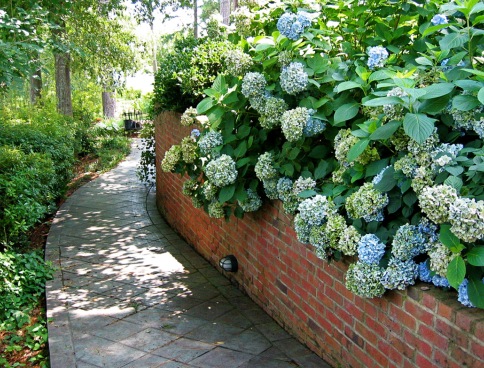
Subsistent wall made of natural stone
The installation of a stone wall requires relatively more material and physical costs, but it is worth it, since such a support looks very beautiful and aesthetically pleasing.
A large plus of a retaining wall made of stone is that previously formed earthen pockets allow plants to plant there. Natural stone is considered the most attractive material from which you can create a retaining wall with your own hands. Basalt, granite, as well as syyenitis are considered the most common types of natural stone. You can give a more ancient type of retaining wall with the help of lime or sandstone. Quickly absorbing moisture, they grow in moss, thereby creating the effect of antiquity. The width of the foundation is always more than 30 cm. Without adhering to this norm, the wall in most cases turned out to be unstable.

How to make a retaining wall on the site with your own hands master class
We make a retaining wall of natural stone 1 meter high with longitudinal drainage.
Step 1. Patch marking
Initially, we choose a place for our support for a slope near the Tersia, located above the ground level. Then, in the corners of the alleged area of \u200b\u200bthe support location, drive pegs and pull the cord.

Step 2. Trench preparation
Cut the soil and shovel a small layer of the earth along the layout contour by a garden knife. Then you should directly go to digging a trench with a depth of 40 cm.

Step 3. Foundation
Carefully align and ram the bottom of the trench. After that, a layer of concrete should be poured, the depth of which should be at least 30 cm. The proportions of the concrete mixture for the foundation: 1 part of concrete, 6 parts of gravel and sand.
If the soil is loose, then before filling the mixture of concrete, it is necessary to build a wooden fence. The concrete pillow should completely dry, this will take about 3 days.

Step 4. Lime layer
After the foundation completely dry before laying the stone, a lime mixture of 2-3 cm should be applied to it. It consists of lime, sand, water and cement. 3-4 parts of the sand are required for 1 part of the negative lime, while each kilogram of this composition needs 300 ml of water. In order to avoid lumps, water must be added a little. After that, cement is added in the ratio: 1 part of the cement per 7 parts of the mixture.
Step 5. Stack laying
Carefully peel the stones from dirt and moisten with water. Stones should be laid more than one on one, since in this case the structure can collapse with the slightest external exposure. The joint of one pair should be located in the middle of the stone of the previous row. On the edges, stones should be laid on the edges, the stones are smaller in the middle, while trying to find their stable position for everyone.

The next row of the walls is set according to the same principle using a lime solution. It is important that the mixture is minimal thickness (1- 1.5 cm), since otherwise too thick seams will collapse faster. In order for the design to be more stable and stronger, it is desirable that its back line is made with a small slope towards the soil, about 5-10 degrees.

It is worth remembering that the broken curved configurations of the retaining walls are more durable, since such a line of the wall has a reduced span length and, accordingly, is exposed to smaller loads, and the rough surface of the posterior wall provides the best adhesion to the ground
Step 6. Drainage and drainage
After each set row of the support between the wall and the soil, a layer of gravel with gravel or small pebbles should be filled up, after which it is thoroughly trim. After laying the second row of the support, it is necessary to take care of the drainage pipe.

Upon completion of the installation of the retaining wall of the excess lime solution, remove with water, sponge and brush.
Landscaping walls in landscape design
Initially, it should be noted that each site has its own individual forms, sizes and relief, therefore, when arranging a retaining wall, there should be its own special approach, given the personal preferences, taste, style of the house, garden and garden paths. For example, if the landscape has a pronounced relief, then a vertical layout will look great, which consists in breaking the site into several horizontal levels, fixed by subpits. If a
the land area is small, it is better to build walls up to 60 cm high, and the bushes along them will grow better. Too larger walls will create a feeling of severity, but if the site involves such buildings, then they should be diluted with various architectural elements, for example, benches, steps, niches, etc.
The choice of material of the retaining wall also directly depends on specific design solutions. If you want to exalt the monumentality of the support, then use embossed, textured materials, install granite large stones laid with a considerable seam, or powerful logs. If, on the contrary, you want to make your relief more sophisticated, inconspicuous and elegant, then perform the walls of the wall with small stones, plaster.
StrPort construction portal 2011-2018. Articles about repair, construction, building materials.
Copying information from the site is possible only with permission of the editorial office Or indicating a direct link to the source. Legal justification
Good article . Useful.
Good article . Useful.
Cool article! I saw here
Cool article! I saw this video https://www.youtube.com/watch?v\u003duhoboza5hbu
It tells how the retaining wall works.
Add to the article))