The pipes that are made of polyethylene are used more actively. Technical ...

|
|
Foam is in wide demand in the building materials market. Among him ... |
Any private plot of land needs to be surrounded by a fence. Sometimes he performs ... |
Insulation of the facade by foam polystyrene
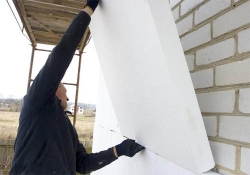
To save heat in the house, it must be insulated. In this article, we will tell you how to properly insulate the facade of a private house using polystyrene foam. Today, it is this material that is most often used when warming houses, since it differs not only in a democratic price, but also excellent technical characteristics and ease of use.
Content:
Characteristics of polystyrene foam
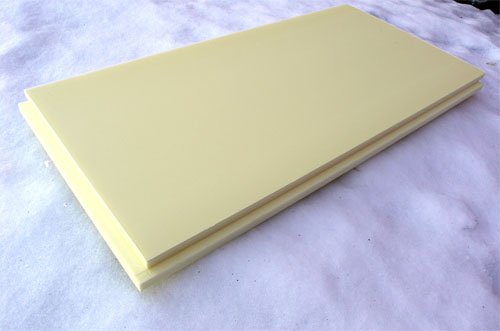
The insulation of the facade with polystyrene foam does not require any special knowledge and skills. However, in addition to ease of use, this material also has a pleasant price and has a number of advantages.
So, the main technical characteristics of polystyrene foam:
- Low cost. This is one of the most tempting virtues of polystyrene foam. So, the cost of insulation of the facade with polystyrene foam will cost cheaper than insulation with basalt wool.
- Easy installation.
- Low thermal conductivity. The thermal conductivity of polystyrene foam 3 cm thick is 43 cm of brick, 25 cm foam concrete and 10 cm of wood. If compared with mineral wool, then the heat conductivity of the polystyrene thermal conductivity is below. As for the varieties of this material, extruded polystyrene foam is the lowest value of thermal conductivity.
- Water resistance. So, in comparison with its main opponent in the market of insulation materials, mineral wool foaming practically does not absorb moisture. This feature allows the insulation for many years to maintain its properties. By the way, there is one interesting feature here: extruded polystyrene foam when immersed in water remains almost dry, while ordinary foam absorbs about 4% moisture. But in the case of the steam, everything happens on the contrary, the usual foam has zero vapor permeability, while extruded polystyrene foam has vapor permeability of 0.019-0.015 kg per meter-pascal. And this is due to the fact that the molding of dense polystyrene foam occurs by cutting, but ordinary polystyrene is not cut.
- Durability. Since polystyrene foam is practically unit by the harmful effects of the environment, its service life significantly exceeds the durability of many heaters. At the same time, polystyrene foam does not tolerate direct sunlight that destroy it and responds poorly to most products obtained by distillation of oil, as well as varnishes, olifa, turpentine and acetone.
On the Internet, you can find a lot of positive reviews about the insulation of the facade of the polystyrene foam, but about the true shortcomings of this material, for some reason everyone prefer to keep silent. But they, these very shortcomings, really are.

Three myths about polystyrene and polyopolistan foam:
- The effect of sound insulation. Here some disappointment awaits you, since in fact the polystyrene foam is not such an ideal soundproof, as the manufacturing companies paint. So, this material is not able to protect the room from the so -called air noise, and from shock noise can only be saved if a sufficiently thick layer is laying.
- Fire resistance. According to some experts, manufacturers are also somewhat cunning, using incomplete data on European standards in the characteristics of the material. The so -called tests with the suspension of the foam plate are not true enough. So, if you put the plate on a non -combustible surface and set fire to it, then it will not go out. The cause of the hot drops of foam, which are formed when a separate piece is heated, will be transferred to the remaining surface of the plate. With this test, the plate burns completely. Antipyrers do not help and the stove will be just as good, but it will light up more slowly. In addition, the properties of antipyrene worsen over time.
- Does not distinguish the poisonous pairs of formaldehyde. With this statement of manufacturers, you can actually argue with polystyrene foam distinguishes sufficiently harmful substances if you leave it in the air and allow the oxidation process. In this case, ordinary polystyrene foam will be oxidized faster than extruded.
Cons of polystyrene foam video:
How not to lose when choosing polystyrene foam
- For insulation of the facade, choose PSB-S material, a brand of at least 40. Polistyle brand 25 and below is not suitable for construction work.
- In addition to the brand, be sure to pay attention to the density, it should not be low.
- Foamylidity with a density of more than 35 kg/cubic meter can only be made by extrusion. Otherwise, its real density cannot have an indicator above 17.
- Low -grade packaging foam from high -quality dense polystyrene foam can only be distinguished by breaking it. So, if at the place of fault you notice an uneven edge and small round balls on its sides, the material is not very high quality. Foam, made by extrusion method, in the place of fault will have the right polyhedra, through some of which the fault line will pass.
DIY Popenia

As already mentioned above, insulation of the facade with polystyrene foam will create heat and comfort in the house at a relatively inexpensive price. In addition, this material is quite easy to use, which means that there will be no problems with its installation. More details on how to prepare the surface and correctly install the insulation further in the article.
In general, the technology of insulation of the facade of the polytyrol foam is the following works:
- preparation of the walls of the house;
- installation of a basement;
- fastening of insulation plates;
- seam processing;
- plaster application;
- application of the finish layer.
Preparation of the walls of the house
If the surface of the wall has any irregularities, it is necessary to remove them or minimize them up to 1-1.5 cm.
Having removed all the irregularities, we continue to prepare the surface of the wall for the fastening of polystyrene foam. If earlier the facade of the building was painted, then the exfolved layers must be carefully cleaned. If the facade was painted with PF paint it must be removed completely.
Completely cleansing the wall, grind the surface. Of course, this stage can be missed, but only on condition that the quality of the wall is perfect. That is, having spent on the surface of the hand, there should be no traces of plaster on the palm of your hand. However, many experts are sure that even in this case, one should not save at this stage.
The order of insulation
Before proceeding directly to laying polystyrene foam, it is necessary to lay a zero basement profile along the entire perimeter of the structure. To do this, we take the usual profile bar and, armed with the level, we attach it to the dowels to the wall. The basement will protect the insulation from groundwater and precipitation.

After the basement is attached, you can proceed directly to gluing the polystyrene plates. If you insulate the facade with extruded polystyrene foam, the sheets of which have a smooth surface, then they will need to be pre -prepared. Your task is to make the surface of the plates more rough to increase adhesion. For these purposes, a needle roller and even an ordinary stationery knife are perfect. It is necessary to process the surface on both sides.
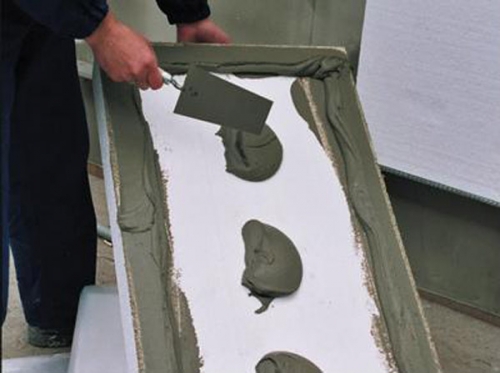
To glue polystyrene foam, you need to use special glue. This can be determined by a special mark and sticker on the glue package for polystyrene foam plates. It should be applied with a uniform layer using a gear spatula. In this case, it is best to apply glue to the surface of the wall, and not on a sheet of insulation. If the glue, nevertheless, will be applied to polystyrene foam, then this must be done around the perimeter of the plate, but in no case on the entire surface.
It is best to start warming the building from the corners, door and window slopes. For insulation of window and door slopes, as a rule, the insulation is thinner than the main one. In this case, the width of the polystyrene foam strip should be equal to the width of the slope and plus a centimeter. Thus, the insulation will protrude slightly beyond the plane of the slope, due to which then it joins well with the insulation of the facade. This will allow you to avoid extra cold bridges.
The facade insulation is usually carried out from the bottom up. The plates themselves, starting from the second row, should continue to be laid with the dressing of the seams, that is, in a checkerboard pattern. At the corners of the building, a gear dressing of insulation plates is performed.
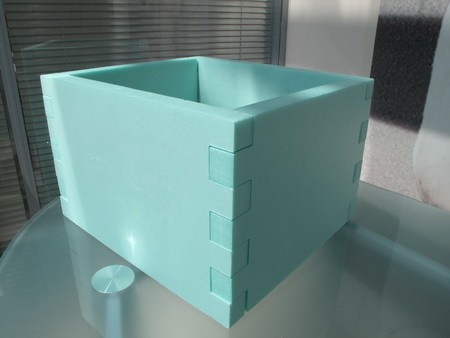
If the insulation lies in two layers, then it must be glued in such a way that the seams do not match. Otherwise, in the places of coincidence, the grounds of the cold are formed.
When the polystyrene foam plates are glued, we leave them for a day so that the glue can grab. Next, the plates are additionally mounted with plastic dowels with metal or plastic nails. At the same time, it is best to use a dowel with plastic nails for fastening polystyrene foam, since they will not form cold bridges.
The dowel can be attached as follows in the way one dowel is clogged into the middle of the plate, and one at the junction of several plates. However, with any mounting method, you should adhere to a retreat 15-17 cm from the edge of the corner. The length of the dowel is 4-5 cm exceeding the thickness of the insulation and the thickness of the glue.

Be sure to make sure that after clogging, the dowel hat is not pressed into the plate more than half a millimeter. If the dowel has not entered the entire length, you can simply cut off the excess using nippers.
After that, the final wall decoration is performed as soon as possible, since the polystyrene foam does not respond well to direct sunlight. However, before that, we must check the plates for gaps. If you find that in the process of installing the polystyrene plate, gaps formed between the plates, they must be closed with installation foam. If the gap is more than a few centimeters, in order to save foam, you can also use strips of insulation.
After the foam dries, after about 4-5 hours, we cut out the excess and close the plate of the polystyrene from the sun. This is done by plastering the facade along the grid or by lining the ventilated facade.
Insulation of the facade with polystyrene video:
Plastering on the insulation
The plastering is carried out by a special mixture for the formation of a protective layer or a universal mixture, which is equally suitable for both the insulation sticker and for the location of the protective layers.

Playing should begin to be made with slopes and angles. If you do not have special corners, you can make them yourself from the main grid. It is enough to cut off the strip of the grid, about 30 cm wide and fold it along. After the home-made angle is ready, we take the mixture and apply it on the corners with a 2-centimeter layer, about 7 cm wide on each side. It puts the angle from the grid on top and smooth it with a spatula. If you notice, part of the grid will not lie on the mixture, but on the foam. There will be nothing wrong with this here with the main grid.
When sticking the mesh on the main surface, the mixture must be applied in such a way that about 10 centimeters of the width of the grid remains free. This is necessary for docking with the next strip of grid. That is, the grid in the joints should be overlapped. At the same time, do not apply too much mixture at once, because it dries quite quickly. The grid should be slightly drowned in the mixture, but at the same time, slightly visible.
After the mixture grabs well, but does not dry to the end (about a day) you need to do a grout. To do this, you can use a plastic grater with sandpaper.
By the way, it is not recommended to save on a reinforcing mesh, as this can lead to an early cracking of plaster.
At the last stage, we, with the same mixture for the formation of a protective layer, align the surface of the wall. It will be sufficient to apply a layer with a thickness of about 3 mm.
That's all, the insulation is done. If you have additional tools, then when final decoration you can effectively decorate the walls of the house by performing a decorative facade of polystyrene foam.
StrPort construction portal 2011-2018. Articles about repair, construction, building materials.
Copying information from the site is possible only with permission of the editorial office Or indicating a direct link to the source. Legal justification