For many years, the townspeople have a garden house with a small summer building that ...

|
|
Residents of our country with the advent of winter are faced with the problem of the cold floor in the house ... |
In order for the strip foundation to serve as a reliable support to the house for as long as possible ... |
The slot between the bathroom and the wall

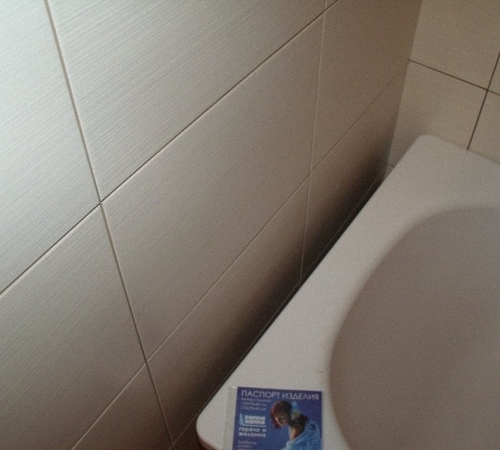
Repair of the bathroom and the installation of a new bath is always a pleasant event, but it is not always possible to install it so that the gap between the bathroom and the wall does not form. It is obtained due to a loose adjustment of the tank to finishing materials. Most often, the dimensions of the bath and a niche for installing it do not coincide. Sometimes its configuration does not coincide with the room, and the angle of the wall in the bathroom does not always form 90. But even when everything perfectly coincides, it is not possible to achieve the complete tightness of the joint with competent installation, especially when lining with decorative tiles. How to close the gap between the bathroom and the wall we will consider in the article.
Table of contents:
- Why do you need to eliminate the gap between the wall and the bathroom
- The choice of material to eliminate the gap between the bathroom and the wall
- The main ways to close hermetic gap near the wall
- Properties of silicone sealant
- What is important to know when starting a gap between the bathroom wall
Why do you need to eliminate the gap between the wall and the bathroom
At any junction of the surfaces in the bathroom, bathroom or pool, it is important to ensure increased tightness so that water does not fall through the gaps. This leads:
- to high humidity;
- chronic dampness in the room;
- breeding mold, fungi and pathological microflora.
As you know, all this is harmful to:
- weakened and elderly people;
- children;
- allergies;
- sensitive to the pathogenic environment of citizens.
With an excess of humidity, building materials and surfaces finish are soaked and lost excellent consumer properties. The damp tile becomes porous, expanded and more fragile, the wood swells and deforms, and cracks are formed on some other materials. Water is known for its property to penetrate the slightest gap, but from there it is poorly excreted by a natural evaporation. This leads to decay and destruction of not only any viscous environment, but also quite strong solid building materials.
If the mold started under the bathroom, where water flows through the clearance, most likely, it will gradually conquer another space. For example, the seams between the tiles or corners near the bathtub will blacken, as well as dark spots at the ceiling, and then it will be most difficult to fight it. If the bath is installed after laying the tiles on the walls of the bathroom, then a large gap is usually formed between the bathroom and the wall where the water occurs when bathing. This defect will somehow have to eliminate the gap between the bathroom and the wall of the video.
The choice of material to eliminate the gap between the bathroom and the wall
There are several options on how to remove the gaps between the bathroom and the wall, and it depends not only on the width of this gap, but also on the general finish. There are secondary factors, such as:
- container configuration,
- the presence of ventilation,
- temperature differences,
- general design.
If the dimensions of the bath approximately coincide with the niche where it should be installed, then experts recommend:
- put the floors under the bathroom,
- install the tank,
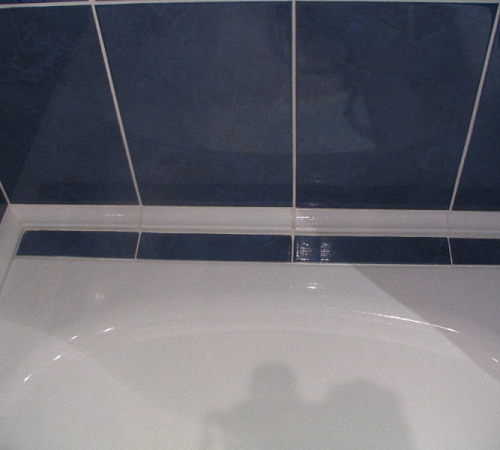
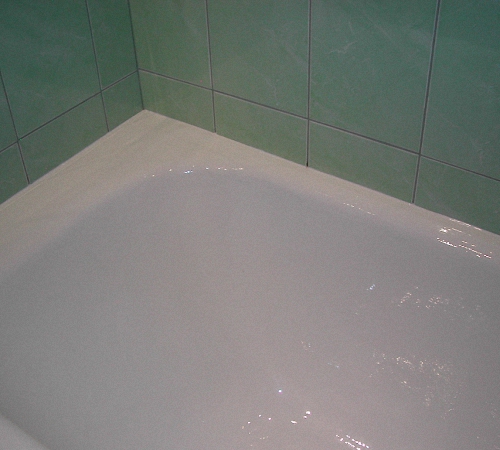
- put the tile or other cladding so that the tile rests on the bath,
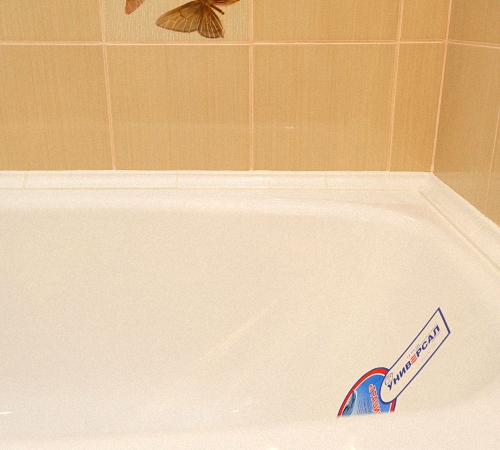
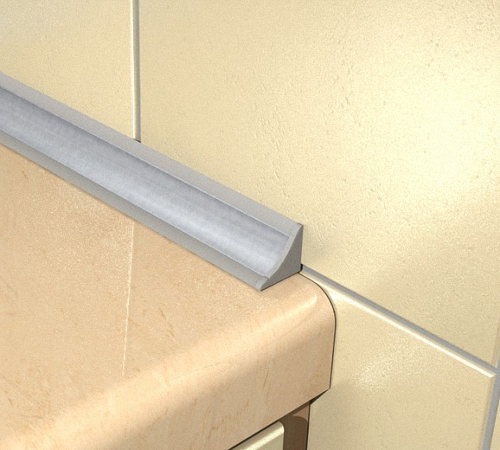
- additionally process the joint with a special tile plinth,
- be sure to close the large cracks between the bathroom and the wall of any kind of border.
Also, the material from which the product is made is also taken into account. For example, an acrylic bathtub should not be treated with rough building materials, but even a small lumen on the wall will still have to be damped or poured with silicone. But this is not enough to eliminate the installation defect, since it will deform and sag under pressure from the acrylic tank. Over time, the tightness of the silicone seal may be disturbed. Special sealants are not always appropriate. And the bath must be additionally attached to the wall so that it does not stand on the legs or pipes for draining.
The container is important to reliably mount, using ordinary hooks or anchor. It is enough to screw them in the corners and in the center of the long side of the container for hygienic procedures:
- baths,
- home mini-basin,
- pallet of the shower cabin.
And although all these containers require various sealing methods, the gap near the wall will have to be eliminated in any case. This is done in different ways, for example, with a special soft ribbon or a hard curb.
The main ways to close hermetic gap near the wall
You can close up a deep gap or a small gap between the bathroom and the wall in different ways, using decorative materials, ordinary grout or sealant. It is important that the filler under them does not fall into the lumen when performing work. There are certain difficulties in how to close the gap between the bathroom and the wall with a large hole. The choice of sealing method depends exclusively on:
- lumen sizes against the wall,
- bathtub stability,
- decorative properties of the finish and the material laid in the seam.
1. You can use the usual plastic profile (corner), which will easily close the small gap or uneven tiles at the junction of the bath. It can be fixed with any building glue or mounting silicone. And the joint on the corner and the ends of the plastic profile must be correctly cut off, accurately measuring the tank in the dimensions. It is important to cut the angle under 45, and the edges are fucked up so that the justification is accurate. Next, a silicone is applied along the edge of the bathtub, which should leak deep into the cracks and harden a little, and only the field of this seam can be closed with a corner. Remove the excess silicone, slightly pressing the plastic profile. What will come out when pressed is superfluous, it must be carefully cut off with a knife after hardening or erased with a damp rag of liquid silicone sealant.

Attention: whatever the solution, glue, foam or sealant when starting the gap between the bathroom and the wall, try to lay them out a little less than necessary, otherwise the seal will turn out to be sloppy. It is better to remove all traces of application until drying, so as not to spoil the surface of the wall and bath with the remnants of the adhesive base!
Tip: Experts recommend sealing the acrylic bathtub only in the condition filled to the top. The entire volume of water is best kept in the container until the silicone dries completely, that is, 12-15 hours.
2. Another way of sealing to use a decorative tiled corner or brothel of small width. In the old fashioned way, narrow strips of a conventional tile laid at an angle of 45 relative to the bath were also used. But this method was not acceptable with a large gap, or the gap had to be sealed with a glazing -a -aid so that a cement mortar would not fall over the bath.

3. Of the modern methods, the most simple method of sealing the gap remains a self -adhesive border tape for the bathroom and a specialized skirting board from plastic. It can also be mounted directly on silicone, but with a large gap, this method is also unacceptable. The installation of the corner is associated with a reliable mount, which requires thorough cleaning and degreasing of both surfaces.
4. Self -adhesive in the form of a curb tape we close up large cracks between the bathroom and the wall competently. It is sold in any construction supermarket in the form of a roll. However, it must be correctly glued to both surfaces so that the seam turns out to be even and neat. Experts recommend gluing a roll tape from the corner, first only on one side of the joint of the wall and bath. The layer, which should reliably stick to smooth surfaces, has a protective film, which is carefully removed 15-25 cm immediately before gluing dry.
Attention: it is important that the container and finishing materials of the wall be absolutely dry, otherwise the gluing will have to be repeated, and the roll will already be spoiled!
5. A fair question how to smear the cracks between the bathroom and the wall, if they are too wide, or when there are gaps diverging angles that have deviations from the right corner at the corner of the bathroom, where the container is installed? The listed methods do not work here. In some cases, special carpentry skills are required to score the slit with wood bar with protective impregnation from moisture and mold. The seams have to be concrete on top, and only then lay the decorative border plastic or tile. The likeness of wooden formwork along the edges of a wide gap holds a concrete solution.
Tip: you can use the listed hints or come up with your own way, based on finishing materials and bathroom design. However, not all materials are suitable for these purposes. For example, the mirror strip laid at the junction at an angle will look original and practical, but over time, moisture destroys the amalgama layer on the back of the glass, ugly stains are obtained. Whatever you decorate the seam, remember practicality and tightness.
Properties of silicone sealant
Modern methods of sealing and sealing seams in rooms with high humidity usually involve the use of silicone sealants. This is a synthetic transparent polymer that resembles liquid rubber or dense gel. It is used for various purposes and when interacting with other building materials. It contains different additives that affect its properties:
- density,
- moisture resistance,
- adhesion.
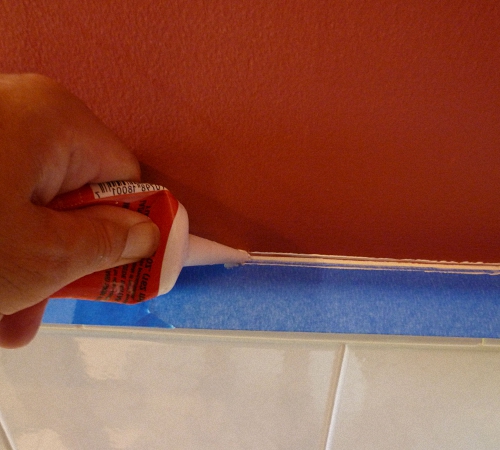
Filling with a moisture -resistant polymer of a seam or lumen between the bathroom and tiles the most common way with a small slit or irregularities of laying tiles. An unsuccessfully processed gap can always be additionally decorated with a plastic profile or even a foam border for painting, but before it hardens.
There are sealants:
- multicomponent,
- one -component.
By chemical composition, silicone sealants offered on sale are divided into:
- acidic;
- neutral.

They differ in the method and time of hardening, since it depends on the chemical reaction or under the influence of an open environment. They react differently to temperature changes, ultraviolet radiation and humidity. That is why it is important to read instructions when buying silicone sealant. Before using it, it is important to clearly imagine:
- a way of applying it,
- hardening time,
- interaction with decorative and finishing materials.
Attention: acid sealant is not suitable for metal surfaces that oxidizes stainless steel or aluminum profile, which leads to corrosion! Experts recommend using only silicone with a neutral reaction.
The rest of the sealant has no minuses, it is reliable and easy to use. It finally dries after 5-12 hours, but it is better to swim in the bathroom no earlier than a day after processing.
However, not everyone knows how to achieve the smoothness and aesthetics of its surface when applying.
Tip: apply silicone sealant a little, evenly, gently trimming the upper layer on the seam between the bathroom and the wall with a spatula. In order not to dirty the joined surfaces, use the masking tape. Remove the excess silicone immediately with a spatula if it hardens with a sharp knife. Any sealant of excess sealants should not be left until hardened, to then cut off, clean them 10-20 minutes after the work and process the adjacent surfaces to remove all traces of the application.
What is important to know when starting a gap between the bathroom wall
1. It is necessary to thoroughly clean all the processed surfaces from abrasive particles, construction debris, mold, rust, calcium calos from prolonged use of water.
2. It is important to degrease and dry the wall and bath before application after cleaning. It is also recommended to use white spite, ethyl alcohol or other volatile solvent for surfaces.
3. The chemical components used by the milking of sealing can be harmful to health, so be sure to use a household respirator. Upon completion of work, be sure to ventilate the room, do not use the bathroom for at least a day, and the container before taking a shower or bath be sure to rinse well with a stream from a flexible shower.
4. Any material used to seal the seam, including sealant and cement mortar, should not drip or fall into the gap in large quantities. The optimal penetration of the composition beyond the edge of the bath is not more than 1cm.
5. Make sure that there are no passes when applying a solution or silicone, otherwise the seam tightness will be disturbed.
6. All tools for applying a cement mortar or sealant should be at hand so that you do not have to search or buy them, while the mixture will harden with snowdrifts.
7. Installation foam can also be used as the main material of the gap of the gap with the lane with a wall and a water capacity. Remember that when hardened, it expands and bursts, adjacent surfaces, and its excess does not look aesthetically pleasing. All the excess must be carefully cut off, and the seam should be closed with a decorative border. The places where it went outside the seam to the bathroom, clean with a rag moistened in a solution of vaults.
8. Border tape for the bath is a great option, but it is short-lived, so it is worth counting on 1.5-2 years of its operation. In addition, it contains a fungicide that prevents mold breeding. It can be recommended for use on top of the mounting foam to close its porous structure.
Attention: when applying decorative finishing materials to the seam, you can also use not only cement mortar and silicone, but also any construction glue, liquid nails, etc. However, the tightness of the seal of the gap itself should be impeccable!
Tip: If there are problems with mold in the bathroom, be sure to clean all surfaces before seaming the seam and treat a special solution of fungicide that prevents its development. Only after that can you start all the work on sealing the seam. Do not think that the mold itself will disappear somewhere after removing the cause of excess dampness, it is very tenacious and harmful to health!
StrPort construction portal 2011-2018. Articles about repair, construction, building materials.
Copying information from the site is possible only with permission of the editorial office Or indicating a direct link to the source. Legal justification