To maintain combustion process, as you know, oxygen is required, ...

|
|
The garage serves not only to protect the iron horse from car lunkers or weather conditions ... |
Roof waterproofing is one of the mandatory stages of its arrangement. Handle... |
Liquid wallpaper on the ceiling: photo, step -by -step instructions

With that assortment of modern finishing materials that the construction market offers today, it is not always possible to choose something original for repairing walls and ceiling. An alternative to decorative plaster, stretch ceilings, ordinary wallpaper, patterned plastic or polystyrene today are liquid wallpaper on the ceiling. Although they combine the properties of plaster and wallpaper, they belong to a separate type of building materials, which are not yet so often used to decorate the ceiling, and few are known to the technology of their application.
Table of contents:
- The basic properties and characteristics of liquid wallpaper
- The main advantages of ceilings with liquid wallpaper
- Advantages of liquid wallpaper over other building materials
- Preparatory stage
- Suspending on the ceiling
The basic properties and characteristics of liquid wallpaper
This material is one of the relatively new types of decoration, therefore it differs from analogues in texture and the method of applying to the surface of the ceiling. Liquid wallpaper is one of the little -known materials used in finishing work, but it is readily used by interiors designers for the effect of novelty when decorating the premises.
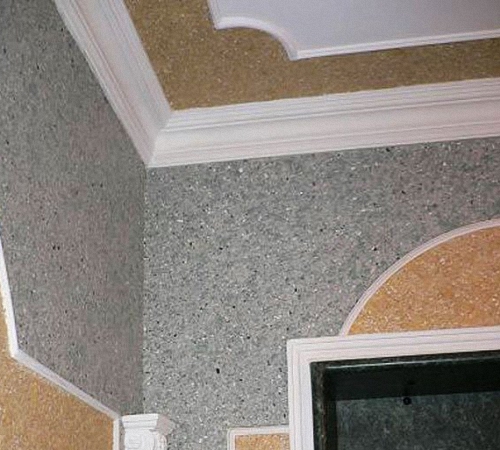
Liquid wallpaper on the ceiling is among the environmentally friendly finishing materials, therefore, they can be recommended for registration or repair in the interior of offices, residential premises and public receptions. According to the classification, they can be attributed to one of the varieties of decorative plaster on an adhesive basis, with the inclusion of textured fillers:
- fibrous mass;
- cellulose flakes;
- micrograss;
- textile components;
- small decorative elements.
When performing recommendations for applying them to the walls and ceilings, there are no problems, including good adhesion and or the convenience of aligning the layer. This material has a lot of advantages, so the masters, once having mastered the technology of their application, often refuse to use traditional plaster or wallpaper.

Liquid wallpaper goes on sale in two forms of production:
- a liquid paste prepared for application with the addition of pigment (in plastic containers);
- a dry mixture packaged in packages, which can be tinted with a pigment of the required shade before applying is diluted with water to a liquid state according to the instructions.
Both varieties have an adhesive base, additives, coloring pigment and fibers. Dry mixtures can also be mixed to obtain transitional textures or shades. At the request of the designer, they add third -party inclusions to make a special image. For example, in the form of a panel, where the pattern passes from walls to horizontal and arched surfaces - liquid wallpaper on the ceiling photo.

Varieties of ceiling liquid wallpaper:
- silk (textile fibers) durable and durable, do not burn out;
- pulp (material based on wood processing) simple budget option;
- silk-cellulose.
Some varieties of texture, with an appropriate shade, imitate other types of finishing materials, and it seems that it is silk, paper, vinyl, traffic jam, wood or bamboo.
The main advantages of ceilings with liquid wallpaper
1. Liquid wallpaper is carried out on the basis of natural materials, do not contain harmful chemical components releasing toxic evaporation, therefore are recommended for decoration of ceilings of the children's bedroom or in the apartment of allergy sufferers.
2. The processed surface is distinguished by antistatic qualities, therefore, they do not attract household dust and other small suspensions, do not absorb odors.
3. Thanks to a slightly loose texture, they contribute to soundproofing, therefore it is recommended to give preference to liquid wallpaper in urban apartment buildings.

4. A special texture containing micropores makes it possible to breathe ceilings, that is, they absorb steam with excess humidity without condensate, and then evaporated it.
5. With all its obvious decorative advantages, the ceiling finish with liquid wallpaper does not cause difficulties when applying and after subsequent care.
6. When soaking and applying, this type of decorative plaster does not emit odors, when liquid wallpaper enters the skin, the mixture does not cause irritation.
7. The addition of special components increased their fire safety, liquid wallpapers belong to the category of RP1 and G1, that is, they do not support combustion and do not spread the flame are not dangerous in fire or evacuation.

8. A sufficient variety of decorative inclusions allows you to create an interesting combination of shades and textures, so they are used to create decorative panels.
9. Thanks to the selection of components, an antistatic effect is achieved, so there is no need to clean the ceiling with liquid wallpaper from dust, that is, the departure is also economical.
10. Liquid wallpaper is pleasant to touch, have a silky texture, although the appearance of cellulose fibers seem to be strict and cold.
11. Before applying liquid wallpaper to the ceiling, the surface is treated with a colorless acrylic primer over the starting putty. When applying, they help to tear small surface defects, where the primary layer of plaster was peeled with concrete ceiling plates.
12. The material is very easy to prepare before application, you do not need special devices and expensive components, you can decorate the ceiling with liquid wallpaper with your own hands.
13. The ability to restore damaged areas an important factor, since not many materials have such a quality. If you leave a little dry material in reserve, then on the site with a defect you can restore the ceiling without affecting the rest of the surface.

14. Thanks to a special texture, additional thermal insulation is created, after processing with liquid wallpaper, it will not be cold in winter and hot summer.
15. Liquid wallpaper is suitable for decorating country houses and dachas without heating, glazed loggias and balconies, as they have sufficient frost resistance. Due to the fibrous texture, they respond plaily to temperature differences, therefore, they are recommended where ordinary wallpaper falls off the ceiling, and decorative plaster can crack.
16. The building materials are successfully used as the finish, hiding small surface defects, due to the variation of the fibrous layer. Therefore, at its own sufficiently high cost, the savings are due to the lack of the need to apply the finish plaster.
17. After application, it resembles textiles, there are no microcracks, joints and seams on the ceiling, without which other building materials are not possible. Liquid wallpaper itself helps to hide the joint of ceiling plates, especially when the error is small.
18. High aesthetics, visually approaching liquid wallpapers to an expensive grinding by finishing textile with a silky texture, gives the room a respectable appearance.
Tip: to apply the mixture simply, but if something is in doubt, use the prompts liquid wallpaper on the ceiling, video.

Advantages of liquid wallpaper over other building materials
1. Convenience at the stage of preparation of the material. A dry fibrous mixture of liquid wallpaper, glue is already part of its composition, has a packaged packaging of small plastic bags. Before applying, the mixture is kneaded on warm water in the proportion indicated in the instructions. It should be well mixed to a pasty consistency, after which the glue should swell at least 8-10 hours. That is, it is enough to prepare a suspension in the evening, and the next morning you can start work.
2. Convenience at the stage of applying liquid wallpaper the finished plastic mass is applied to the prepared surface, smoothing with a rectangular ironer (plastic cell). The light mass is not falling off in pieces, as is the case with heavy building materials, but stuck and aligns well. There is no need to use auxiliary devices, such as a second spatula. Therefore, all manipulations can be done independently and only with one hand, scooping up a little mass from the container.
3. The simple final stage at the drying stage should not be afraid of the temperature difference, drafts or ventilation. All this will only benefit, accelerating the hardening process of the applied mass. Due to the plasticity of liquid wallpaper, the work on their application can be done with open windows in the heat or in wet weather, but it is important to ensure periodic ventilation.
4. The possibility of partial restoration when it is damaged by a small area on the ceiling can be cleaned and covered with a spot that will not be noticeable. This is convenient if the roof periodically leaks, damps the corner or closes the wiring, forming small tan. In this case, there is no need for the full repair of the ceiling or walls. The glue that is part of the mixture, when soaked, again acquires plasticity and is well connected to a new layer of liquid wallpaper. With a plastic grater, you can fix the defect in a few minutes, and after a couple of days the color of the flap is leaving, due to the general drying. There will be no traces on the ceiling, so this is additional savings in the general repair of the ceiling.
5. A simple way to remove from the surface in liquid wallpaper will also expire, and when this design is tired or they are morally obsolete, the ceiling will have to be updated. It is enough to arm yourself with a fur roller, a sprayer with water and a spatula to remove the unnecessary layer.
Tip: Soak the liquid wallpaper well by roller, gradually adding water from the spray gun, if the process of wetting is not so fast. Further, it remains only to carefully remove the mass with separate fragments, gradually spraying, if necessary. Plastic mass is removed without difficulty.

6. The ability to expand the scope of liquid wallpaper with a creative approach. Not every building material is as plastic as this one, so that it can be easily applied to arches, curvatures, smoothly flowing surfaces, like this mass. Any ceilings and geometric shapes at the ceiling can easily be covered with a layer of liquid wallpaper. People with artistic taste and creative abilities use this material to create picturesque panels and embody original design ideas.
Tip: When mixing liquid wallpaper of different textures and colors, original combinations are obtained to embody the most daring ideas. Make a whole forest with trees, animals, birds and clouds on the ceiling in a children's room with liquid wallpaper. By texture, this will resemble a silky carpet, with feathers of birds and animal pile. It is better to use a mixed type of wallpaper, silk-cellulose.
Preparatory stage
The technology of surface processing and application to the ceiling is quite simple, consists of 3 stages:
- surface preparation;
- breeding a fibrous mixture;
- application and alignment of the finished suspension on the ceiling.
1. It is important to remove the old layer of wallpaper or other finish coating from the plane, for example, scraping the paint or enamel of the ceiling with special washing. Acrylic and water -based paint is usually left, since they have a common water base.
If there are irregularities, cracks and defects, they must be treated with starting putty. All areas that are divided or irradiated are cleaned with a metal brush or spatula. After the putty dries, you can apply a primer layer to the ceiling, which gives good adhesion (clutch) with any finish coating, including liquid wallpaper.

Tip: in some apartments there is such a rude seam between the floor slabs that the ceiling has to be closed. The easiest way to level drywall, since even a thick layer of plaster can not always save the situation. If the suspended and suspended ceilings are not your option due to a low room, it is much cheaper to use drywall. Sometimes liquid wallpaper is also used in the center of multi -level structures, which also successfully hide all defects in the difference in ceiling plates.
We pour the amount of warm water into the capacity of the appropriate volume, which is indicated in the instructions for the dry mixture. It is important to follow the proportions, and if at the final stage it is used for the entire volume of the bag, be sure to move everything and check everything. The dry mixture is gradually poured into the water with thoroughly stirring, as the most uniform suspension is ensured. After 8-12 hours of swelling, she is ready. If during operation the mixture seems too viscous, you can add a little more water.
Suspending on the ceiling
On the prepared surface of the ceiling, after drying the primer, you can prepare the mixture. You will need:
- a container for obtaining a liquid suspension;
- drill with a nozzle (evenly stir the batch);
- plastic cell or ironer;
- putty knife;
- roller.
Liquid wallpaper can be applied not only manually, but also mechanized. The manual method involves the operation of a cell, and a texture roller, a hard brush and a construction spatula as it is more convenient with a certain form of liquid wallpaper. In some options for designer ideas, it is easier to immediately level liquid wallpaper using a structural roller, and the boundaries of the picture can be made with a rubber spatula or marker. The pulverizer gun makes it possible to apply a suspension with a mechanized method, accelerating the process of coating the ceiling surface. The layer should not exceed 3 5 mm, depending on the texture.

1. The spatula provides a smooth surface, but a special texture can be formed 5-6 hours after application.
2. A structural roller moistened in water can be formed.
3. A metal brush is able to provide the effect of a rough surface, a stroke of fur on the skin of animals and leaves created on the panel.
When the application process is completed, the ceiling must dry the 2nd day with mandatory ventilation of the room. When dried, some decorative elements are added, including beads, cutting colored yarn or wool, sparkles. Silk liquid wallpaper is more suitable for panels, and it is important to monitor the uniformity and accuracy of their application. If the idea requires a layer in some places can be thicker than the main background.
With this noble and plastic material, you can create an original design of ceilings - with liquid wallpaper you can decorate the hallway and living room, dining room and sleeping, the surface above the stairs. From the pre -developed sketch with a pencil, the boundaries of colored zones are marked and then work as usual.
Tip: If there is a desire to apply liquid wallpaper in a bathroom or pool, the surface of a decorative panel must be protected from excess moisture with acrylic varnish. It is applied in 2-3 layers with a mandatory pause for drying.
StrPort construction portal 2011-2018. Articles about repair, construction, building materials.
Copying information from the site is possible only with permission of the editorial office Or indicating a direct link to the source. Legal justification